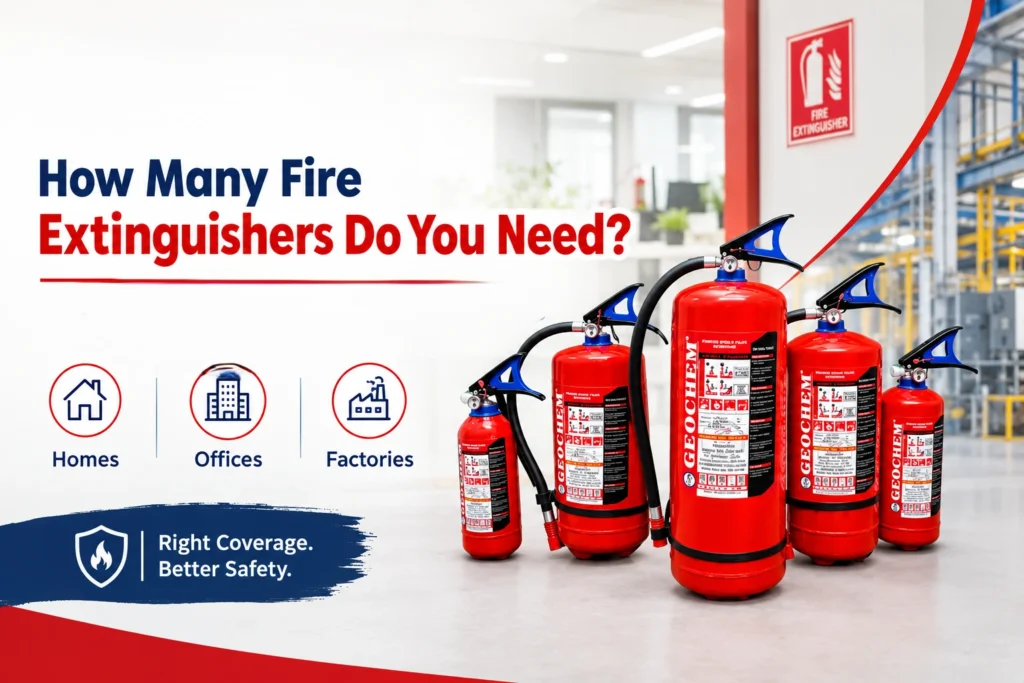
How many fire extinguishers do I need? The answer depends on your floor area, the fire risks inside and how quickly someone can reach an extinguisher. One of the most common mistakes we see is assuming that one cylinder protects a whole building. This guide explains the basic rules used in India and shows what they mean for a home, a shop, an office and a factory.
Quick answer: NBC guidelines commonly recommend one fire extinguisher for every 200 square metres of floor area, depending on the hazard level, and offices typically plan for at least one for every 200–300 m². Nobody should have to walk more than about 15 metres to reach one. A home should have at least one extinguisher on each floor.
The rules that decide the number
In India, portable fire extinguishers are selected, installed and maintained under IS 2190, and the National Building Code (NBC) 2016 Part 4 sets the fire safety requirements for buildings. Three checks decide your count.
1. Floor area
Start with about one extinguisher for every 200 m² of floor area. Low-risk spaces such as offices are often planned at one for every 200–300 m², while higher-risk areas need more.
2. Travel distance
Nobody should have to walk more than about 15 metres to reach an extinguisher. On long floors, or floors divided by cabins, racks or machines, this check often adds units.
3. The type of risk
The number and type should follow a fire risk check of the space: electrical hazards, flammable materials, equipment that can overheat and other high-risk zones. Areas such as electrical panels, server rooms, kitchens and fuel stores each need the right extinguisher type close by.
Fire NOC authorities, factory inspectors and insurers often set the final number and size for a building, so confirm your plan with them. Our guide on how to get a fire NOC in India explains that process.
How many fire extinguishers do I need at home?
A typical home should have at least one fire extinguisher on each floor, so one is always within reach in an emergency.
- Flat or single-floor home: one 2 kg ABC fire extinguisher near the living area or the main switchboard.
- Larger house: a 4 kg ABC unit gives more capacity.
- Multi-storey house: at least one extinguisher on every floor.
- Electrical panel: many homes add a 2 kg CO2 extinguisher near electrical panels.
- Kitchen: a fire extinguisher ball in the kitchen gives passive protection, and a fire blanket handles small pan fires. Do not use ABC powder on cooking oil fires.
Most homes use 2 kg to 4 kg units because they give enough discharge time and are still easy to handle. Smaller 1 kg units can discharge too quickly in a real fire. See our full guide to choosing a fire extinguisher for home use.
How many fire extinguishers does a shop need?
A 4 kg ABC fire extinguisher is the most common choice for shops. For most small shops, one unit near the counter and one near the storeroom gives good cover. Larger showrooms should follow the floor-area and 15-metre checks above.
How many fire extinguishers does an office need?
Offices contain computers, printers, wiring, paper and air conditioning units, so they need both general and electrical protection. Office fire safety typically calls for at least one extinguisher for every 200–300 m².
Example: a 1,000 m² single-floor office
- Floor area: 1,000 ÷ 300 = 3.3, rounded up to 4; 1,000 ÷ 200 = 5. Plan for 4 to 5 ABC units.
- Size: 4 kg ABC is the usual office size; larger offices often use 5–6 kg units.
- Travel distance: walk the floor and add a unit wherever a desk is more than about 15 m from the nearest one.
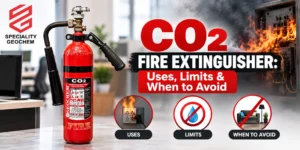
- Electrical areas: add a CO2 fire extinguisher near the UPS room, server room and main panels. For electrical rooms, a 4.5 kg CO2 unit is a common choice.
CO2 is preferred for server rooms and electrical panels because ABC powder leaves residue that can damage electronics. Read more about the co2 fire extinguisher for electrical fire risks.
How many fire extinguishers does a factory need?
Factories and warehouses usually need larger units and more of them, because they combine large areas with flammable materials, machinery and electrical loads.
Example: a 3,000 m² manufacturing unit
- Floor area: 3,000 ÷ 200 = 15 ABC units as a starting point.
- Size: 6 kg ABC for production floors and warehouses; 9 kg ABC for industrial and fuel zones. Large open areas can also use trolley units.
- Flammable liquids: add a 9-litre mechanical foam extinguisher for petrol, oil and solvent storage.
- Machinery and motors: add 6 kg CO2 units near electrical machinery.
- Travel distance: make sure no point is more than about 15 m from an extinguisher; add units where racks or machines block the route.
Factories under the Factories Act must also keep proper inspection records, and fire NOC inspections check that extinguishers are installed according to IS 2190.
Which fire extinguisher types go where?
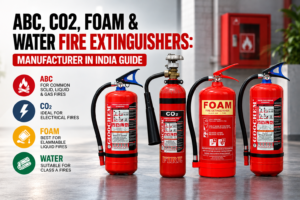
The right fire extinguisher types matter as much as the count.
| Area | Recommended extinguisher |
|---|---|
| Homes, living areas, corridors | ABC dry powder (2 kg to 4 kg) |
| Offices and shops | ABC dry powder (4 kg) |
| Server rooms, UPS rooms, electrical panels | CO2 (no residue, non-conductive) |
| Factories, warehouses, workshops | ABC dry powder (6 kg to 9 kg) |
| Petrol, oil, paint and solvent storage | Mechanical foam (9 L) |
| Wood, paper and cloth only | Water (9 L); never on electrical or oil fires |
| Restaurant and commercial kitchens | Wet chemical (Class K) |
Choosing the right size
| Size | Ideal for |
|---|---|
| 1 kg ABC | Cars, small kitchens |
| 2 kg ABC | Homes, apartments |
| 4 kg ABC | Offices, shops |
| abc fire extinguisher 6 kg | Factories, warehouses |
| 9 kg ABC | Industrial and fuel zones |
Choose a size that the people in that space can comfortably lift and use. Our ABC powder fire extinguishers come in all five sizes. For current rates, see our fire extinguisher price in India guide.
Can a fire extinguisher ball replace a cylinder?
No. A fire extinguisher ball can be legally bought and installed in India as a supplementary device, but it cannot replace BIS-certified extinguishers required under NBC 2016. Use fire balls for extra protection near electrical equipment or enclosed hazards, alongside your portable extinguishers.
Where to place your fire extinguishers
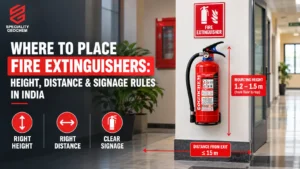
- Near exits and escape routes, close to the hazard but not deep inside the risk area.
- With the carrying handle about 1 to 1.5 metres above the floor.
- Clearly visible, with signage above, and never blocked by stock, furniture or doors.
- Away from direct heat, rain and long exposure to sunlight.
- Make sure everyone in the building knows where they are.
Keep them ready: inspection basics
An extinguisher only counts if it works. Under IS 2190:2010, extinguishers need monthly checks by trained in-house staff, quarterly checks and annual servicing by a certified fire safety technician. Refill any fire extinguisher cylinder immediately after use, even a short burst, and keep an inspection register; fire NOC renewal in most states asks for proof of annual servicing. See our fire extinguisher inspection in India guide for the full checklist.
Frequently asked questions
Q1. How many fire extinguishers do I need per square metre?
NBC guidelines commonly recommend one fire extinguisher for every 200 m² of floor area, depending on the hazard level. Offices typically plan for one per 200–300 m². Nobody should have to walk more than about 15 metres to reach one.
Q2. How many fire extinguishers should a house have?
A typical home should have at least one fire extinguisher on each floor. A 2 kg ABC unit suits most homes, and a 4 kg unit suits larger houses.
Q3. How many fire extinguishers does a small shop need?
For most small shops, one 4 kg ABC extinguisher near the counter and one near the storeroom is enough.
Q4. Which fire extinguisher is best for an office?
A 4 kg ABC fire extinguisher for general areas, plus a CO2 fire extinguisher near server rooms, UPS rooms and electrical panels.
Q5. Do I need fire extinguishers for a fire NOC?
Yes. During fire NOC inspections, authorities check that the building has NBC-compliant, BIS-certified extinguishers installed according to IS 2190, along with inspection records.
Q6. Can a fire extinguisher ball replace a cylinder?
No. It is a useful supplementary device, but it cannot replace BIS-certified portable extinguishers required under NBC 2016.
Q7. Plan the right number with Speciality Geochem
Start with about one extinguisher per 200 m², check the 15-metre walking distance, and match each type to the risk. Speciality Geochem has manufactured ISI-marked fire extinguishers in Udaipur since 1996. Browse our fire extinguisher cylinder range for a free quote for your home, shop, office or factory.