
An extinguisher that nobody can reach in time is just a red cylinder on the wall. Fire extinguisher placement decides whether the unit gets used in the first seconds of a fire or stays where it is while the fire grows. This guide to fire extinguisher placement sets out the rules in plain terms, then applies them space by space: home, kitchen, office, factory and vehicle.
Why fire extinguisher placement matters
Fires spread fastest in their first minutes, and that is exactly when someone needs to find, lift and use an extinguisher. Common errors such as poor placement and blocked access are among the reasons extinguishers fail in real emergencies. Under IS 2190, extinguishers must also stay visible and accessible without moving any object, and inspectors check this during fire NOC and factory audits.
Six rules for fire extinguisher placement
Rule 1: Put it on the way out. Keep extinguishers near exits and along escape routes, so you face the fire with a clear way out behind you.
Rule 2: Near the hazard, not inside it. Place the unit close to the risk area, but not directly beside it. If a fire blocks the hazard zone, you still need to reach the extinguisher.
Rule 3: Always visible. Never hide it behind doors, inside cupboards, or behind stock or furniture.
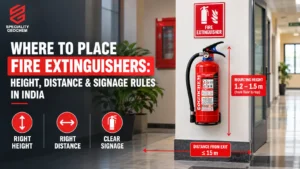
Rule 4: Mount it at a height people can lift from. Keep the carrying handle about 1 to 1.5 metres above the floor.
Rule 5: Keep the walking distance short. Nobody should have to walk more than about 15 metres to reach an extinguisher.
Rule 6: Protect it from the elements. Keep it away from direct heat, rain and long hours of sunlight.
These six rules are the core of any fire extinguisher installation guidelines. For how each type works, see our fire extinguisher cylinder guide.
Fire extinguisher mounting height and brackets
The right fire extinguisher mounting height lets most people lift the unit off its bracket without stretching or bending. Keep the carrying handle about 1 to 1.5 metres above the floor.
Always use a wall bracket or stand. A bracket keeps the cylinder upright, visible and in a fixed place that everyone learns, and it stops the unit being moved, knocked over or buried behind boxes. In vehicles, use a firm bracket so the cylinder cannot roll.
Fire extinguisher travel distance and coverage
Fire extinguisher travel distance is the distance a person has to walk from any point to the nearest unit. Keep it to about 15 metres. On long floors, or floors split by cabins, racks or machines, walk the space yourself and add a unit wherever a spot is further than that.
Floor area matters too. Larger areas need more units, and higher-risk areas need more than low-risk ones. Your fire NOC authority, factory inspector or insurer often sets the final number. Our ISI-marked fire extinguisher cylinder range covers 1 kg to 9 kg, so you can match size to each area.
Placement by space
Home
- At least one extinguisher on each floor
- Near the living area or main switchboard, on the route out of the house
- A 2 kg ABC unit suits most homes
This is the short answer to where to keep fire extinguisher at home. Our fire extinguisher for home page covers sizes and types in more detail.
Kitchen
- Keep the extinguisher near the kitchen door, not directly beside the stove
- ABC powder is not recommended for cooking oil fires; keep a fire blanket for pan fires, and use wet chemical units in commercial kitchens
- A fire extinguisher ball can be fixed above the stove or near the gas line as an extra, automatic layer
Office
- Near exits and near electrical boards
- A CO2 unit beside the server room, UPS room or main panel, where powder residue would damage equipment
- Spread units along corridors so every desk is within about 15 metres
Factory and warehouse
- Near machinery, motors and production lines, but not inside the danger zone
- Foam units near fuel, oil and solvent storage
- Trolley units for large open areas
- Keep racking and stock clear of every unit
Vehicle
- Within easy reach of the driver’s seat
- Fixed on a firm bracket: under the driver’s seat, near the passenger footwell, or in the boot on a bracket
- Away from direct heat and sunlight
Signage and markings
Signage is part of every set of fire extinguisher installation guidelines, because people must be able to find an extinguisher in smoke and panic, not just on a calm day. Put a clear sign above each unit, and keep it unblocked. NBC 2016 Part 4 requires signage that shows where extinguishers are.
Cylinders are also colour-coded so the type can be identified at a glance. Learn what each band means in our guide to the fire extinguisher colour code in India.
Common fire extinguisher placement mistakes
| Don’t | Do instead |
|---|---|
| Keep the extinguisher in a locked cupboard or storeroom | Mount it on a wall bracket where everyone can see it |
| Put it right next to the stove or panel it protects | Place it close to the hazard, on the escape route |
| Let stock, furniture or doors block it | Keep the space in front of it clear at all times |
| Mount it too high or leave it on the floor | Keep the handle about 1 to 1.5 metres above the floor |
| Leave it in direct sun or rain | Choose a shaded, dry wall |
| Use one cylinder for a whole building | Add units until no point is more than about 15 metres away |
| Skip the sign | Put a clear sign above every unit |
Frequently asked questions
Q1. At what height should a fire extinguisher be mounted?
The recommended fire extinguisher mounting height puts the carrying handle about 1 to 1.5 metres above the floor. At that height most people can lift it off the bracket quickly, without stretching or bending, and it stays visible above furniture.
Q2. How far should an extinguisher be from any point in a room?
Keep the fire extinguisher travel distance to about 15 metres: nobody should have to walk further than that to reach one. On long floors, or floors divided by cabins, racks or machines, add units wherever a spot is further away.
Q3. Can I keep an extinguisher in a locked cupboard?
No. An extinguisher must be visible and reachable without moving anything. A locked cupboard costs seconds you do not have, and it will fail a fire audit. Mount it on a wall bracket near an exit instead.
Q4. Where to keep a fire extinguisher at home?
Keep at least one on each floor, near the living area or main switchboard and on the route out of the house. Keep it near the kitchen door rather than beside the stove, and add a fire blanket for cooking oil fires.
Q5. Do extinguishers need signage?
Yes. Put a clear sign above each unit so people can find it quickly, even in smoke. NBC 2016 Part 4 requires signage that shows where extinguishers are installed.
Need the right units for your space?
We manufacture all four ISI-licensed types (ABC, CO2, foam and water) in sizes from 1 kg for cars to 9 kg for factories. Call +91-9799661841 or email sales@new.specialitygeochem.com to plan fire extinguisher placement for every spot in your building.