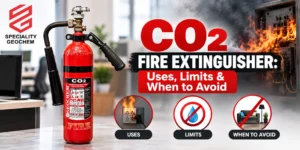
A CO2 fire extinguisher is the one people reach for when the fire involves something they cannot afford to damage: a server rack, an electrical panel, a lab instrument. It leaves nothing behind. But it is not a universal answer, and using it in the wrong place can waste the few seconds you have. This guide covers CO2 fire extinguisher uses, the fires it handles, its advantages and disadvantages, and the situations where you should pick something else.
use a CO2 fire extinguisher on flammable liquid and electrical fires, especially around sensitive equipment, because it does not conduct electricity and leaves nothing behind. Do not rely on it for deep-seated fires in wood, paper or cloth, or outdoors.
How a CO2 extinguisher works
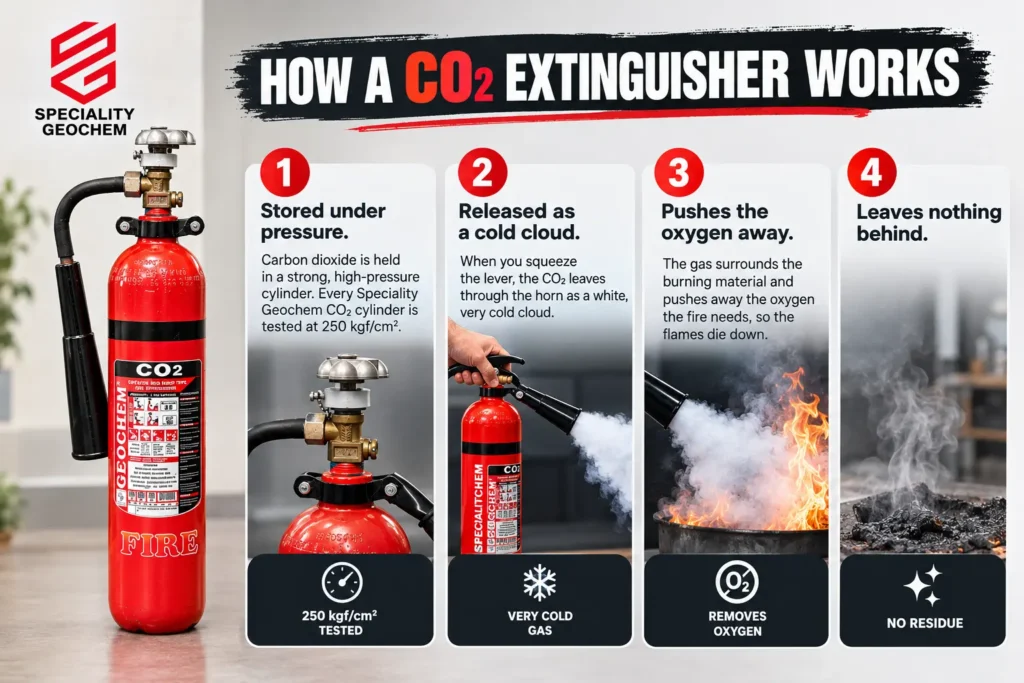
- Stored under pressure – Carbon dioxide is held in a strong, high-pressure cylinder. Every Speciality Geochem CO2 cylinder is tested at 250 kgf/cm².
- Released as a cold cloud – When you squeeze the lever, the CO2 leaves through the horn as a white, very cold cloud.
- Pushes the oxygen away – The gas surrounds the burning material and pushes away the oxygen the fire needs, so the flames die down.
- Leaves nothing behind – The CO2 disperses into the air. There is no powder or liquid to clean up and nothing to damage electronics.
Fire classes it handles, and where it doesn’t work
| Fire type | Examples | Use CO2? |
|---|---|---|
| Class B: flammable liquids | Petrol, diesel, oil, paints, solvents | Yes |
| Class C: gases and live electrical equipment | LPG, wiring, panels, servers, machinery | Yes |
| Class A: deep-seated solids | Wood, paper, cloth, furniture | Not the first choice; use ABC or water |
| Cooking oil in a kitchen | Kadhai or fryer fires | No; use a fire blanket or wet chemical unit |
That makes the CO2 fire extinguisher for electrical fire risks the standard pick in offices, labs and plant rooms. Our product page and brochure list electrical fires under Class C. Some guides, including our classes of fire article, call electrical fires Class E. Either way, CO2 is suitable for them.
Where to use CO2 extinguisher units: best places
The most common CO2 fire extinguisher uses are in places where powder residue would cause damage:
- Server rooms and data centres, where powder can ruin hardware
- Electrical panels, switchgear and UPS rooms, because CO2 does not conduct electricity
- Control rooms and laboratories, with sensitive instruments
- CNC machines and machinery areas, near motors and controls
- Offices, beside the main panel and server cabinet
A CO2 fire extinguisher for electrical fire risk should sit near the panel it protects, but not so close that a fire would block your way to it. See all models on our CO2 fire extinguisher page.
CO2 extinguisher advantages and disadvantages
| Advantages | Disadvantages |
|---|---|
| Non-conductive, so suitable for live electrical equipment | Not the first choice for deep-seated wood, paper or cloth fires |
| Leaves no residue, so no clean-up and no damage to electronics | Short jet of about 1 metre, so you must get close |
| Works on flammable liquid fires as well | Short discharge time, from 6–8 seconds on a 2 kg unit |
| Clean choice for sensitive equipment | The gas disperses, so a fire can flare up again once it clears |
Weighing the CO2 extinguisher advantages and disadvantages together explains why most buildings use both types: CO2 near electrical equipment, and ABC dry powder for general areas. Our ABC vs CO2 fire extinguishers guide compares them side by side.
Limits and safety points
Knowing the limits matters as much as knowing the CO2 fire extinguisher uses.
- Outdoors and in wind – The gas blows away quickly in open air, so it may not hold long enough to put the fire out.
- Re-ignition – CO2 does not leave a coating on the fuel. Watch the area after the flames are out, and step back if the fire returns.
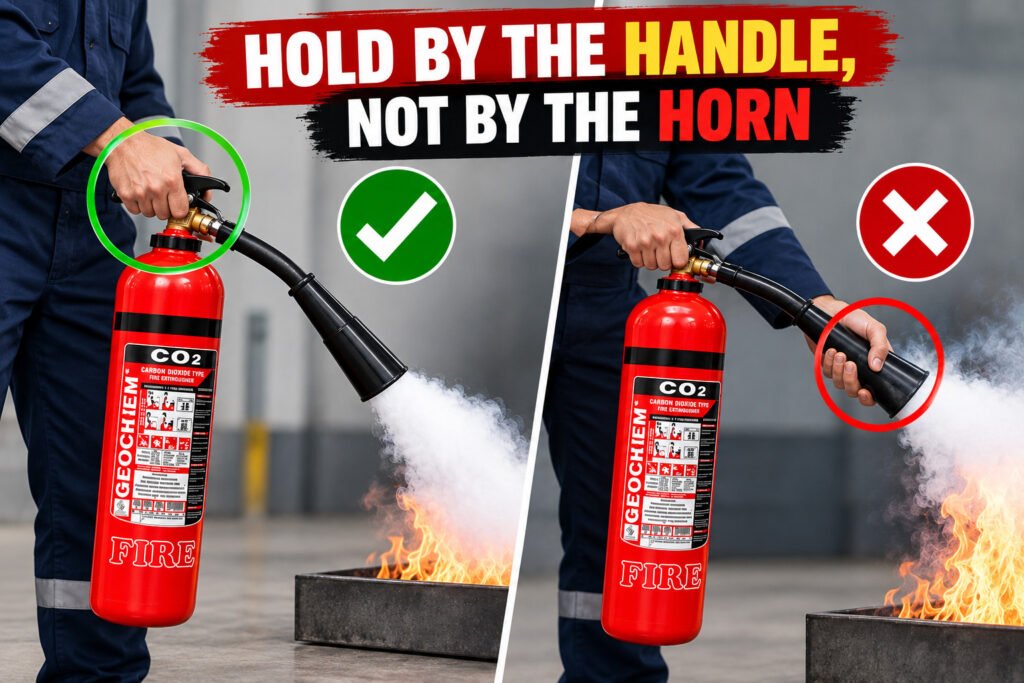
- Cold discharge – The horn and the gas become extremely cold during use. Hold the extinguisher by its insulated handle, never by the horn.
- Closed rooms – CO2 displaces oxygen. In a small, closed room, leave as soon as the fire is out and ventilate the space before anyone goes back in.
If the fire spreads quickly or the room fills with smoke, leave and call 101.
Sizes and discharge time
We make two CO2 sizes, both to IS 15683 under ISI licence CM/L 2533146:
| Size | Discharge time | Jet length | Test pressure | Typical use |
|---|---|---|---|---|
| 2 kg | 6–8 seconds | 1 metre | 250 kgf/cm² | Offices, cabins, small server rooms, panel boards |
| 4.5 kg | 10–18 seconds | 1 metre | 250 kgf/cm² | UPS rooms, electrical rooms, labs and larger panels |
The CO2 fire extinguisher 4.5 kg model is the common choice for electrical rooms, because it gives a longer discharge than the 2 kg unit.
Inspection and the weight-check method
Most CO2 extinguishers do not have a pressure gauge, so you cannot check them by looking at a needle. Instead:
- Look at it every month – Check the body for dents and rust, make sure the safety pin and seal are intact, and check that the horn and hose are not cracked or blocked.
- Weigh it – During servicing, the cylinder is weighed and compared with the weight marked on it. A unit that has lost weight has lost gas and must be refilled.
- Refill after any use – Even a short burst lowers the charge. Get it refilled by an authorised provider before putting it back.
- Keep the tag up to date – Record each service date on the tag.
For general cylinder care, see our fire extinguisher cylinder guide.
Buy CO2 extinguishers from the manufacturer
Speciality Geochem makes 2 kg units and the CO2 fire extinguisher 4.5 kg model in Rajasthan, ISI-licensed under IS 15683. For any of these CO2 fire extinguisher uses, and for bulk orders for offices, data centres, labs or factories, call +91-9680211841 or email sales@new.specialitygeochem.com.
Frequently asked questions
Q1. Can a CO2 extinguisher be used on electrical fires?
Yes. A CO2 fire extinguisher for electrical fire risks is one of the best choices for panels, switchgear, UPS rooms and server rooms, because CO2 does not conduct electricity and leaves no residue. Switch off the power if it is safe to do so, and keep your hands on the insulated handle.
Q2. Is a CO2 extinguisher safe to use in a closed room?
It can be used, but CO2 displaces oxygen. In a small, closed room, use it from the doorway if you can, leave as soon as the fire is out, and ventilate the room before anyone goes back in.
Q3. Why is a CO2 extinguisher horn not to be held?
The horn gets extremely cold as the gas is released and can cause cold burns to bare skin. Always hold the extinguisher by its insulated handle and aim the horn at the base of the fire.
Q4. What is the discharge time of a 4.5 kg CO2 extinguisher?
Our CO2 fire extinguisher 4.5 kg model discharges for 10 to 18 seconds, with a jet length of about 1 metre. The 2 kg model discharges for 6 to 8 seconds.
Q5. CO2 vs ABC extinguisher: which is better for offices?
Use both. An ABC dry powder extinguisher covers general areas with paper, furniture and wiring. A CO2 extinguisher belongs beside server rooms, UPS rooms and electrical panels, where powder residue would damage equipment. If you are unsure where to use CO2 extinguisher units, start with every electrical panel.