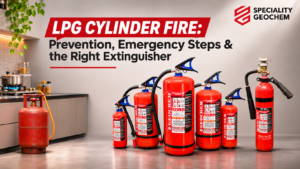
Almost every Indian kitchen runs on an LPG cylinder, and most of the time it is perfectly safe. The danger comes from gas that escapes where it should not: through a cracked tube, a loose regulator or a knob left open. This guide covers LPG cylinder fire safety from both sides: how to stop a leak from becoming a fire, and what to do, second by second, if a flame does appear.
If you smell gas right now: do not switch anything on or off, turn off the regulator, open doors and windows, and leave the kitchen. If the smell does not clear, call your gas distributor’s emergency service from outside.
Why LPG fires are dangerous
LPG is heavier than air, so leaked gas does not drift away. It settles near the floor and collects in corners, under the platform and in closed cabinets, until a spark finds it. That spark can be anything: a light switch, a mobile phone charger, a matchstick or the stove itself.
When it ignites, an LPG gas leak fire can flash across the whole kitchen in a moment, and a flame burning at a leaking regulator or tube keeps feeding on fresh gas for as long as the supply stays open. That is why LPG cylinder fire safety starts with the gas, not the flame.
Signs of a gas leak
- Smell. LPG has a strong smell added to it so that leaks can be noticed. If you smell it, act at once.
- Hissing. A faint hissing sound near the cylinder valve, regulator or tube.
- A cracked or hardened tube. Bend the rubber tube gently; cracks or stiffness mean it can leak.
- Burner trouble. A flame that keeps going out, or a knob that does not close fully.
Never look for a leak with a flame or a lighter. A soap solution brushed on the joint will bubble where gas escapes, but if you can smell gas, leave the testing to your distributor.
[IMAGE 2: signs of an LPG leak]
Prevention checklist: regulator, tube and ventilation
Good LPG cylinder fire safety is mostly routine. Work through this list once, then keep it as a monthly habit:
- The cylinder stands upright, on the floor, never in a pit or a closed cabinet
- The stove sits on a platform above the level of the cylinder
- The regulator is switched off at night and whenever you leave home
- The tube is a Suraksha LPG hose, checked for cracks and replaced before its expiry date
- The tube is not passing behind the stove or touching hot surfaces
- The kitchen has a window or vent that stays open while you cook
- No shelves or cabinets sit directly above the burners
- Your LPG installation has been checked by the distributor in the last two years
These habits cut the risk of an LPG gas leak fire at the source. Kitchen gas fire safety also means keeping the right equipment within reach, covered below.
What to do in the first 60 seconds
If you smell gas but there is no fire:
- Do not touch any electrical switch, and do not light a match or the stove.
- Turn off the burner knobs and the regulator.
- Open all doors and windows to let the gas out.
- Get everyone out of the kitchen.
- If the smell stays, remove the regulator, fit the safety cap on the cylinder valve and call your gas distributor’s emergency service, or the LPG emergency helpline 1906, from outside.
If the leak has caught fire:
- Shout to warn everyone in the house.
- If you can reach the regulator safely, turn it off. Cutting the gas supply is what actually stops an LPG fire.
- For a small flame at the regulator or tube, smother it with a fire blanket.
- For a fire that has spread to nearby objects, use an ABC fire extinguisher from a safe distance, keeping your exit behind you.
- If the flames are large, or you cannot reach the regulator, leave at once and call 101.
This is the core of how to extinguish LPG fire safely: stop the gas first, then deal with the flame.
Which extinguisher works on LPG fires
LPG is a flammable gas, so an LPG fire is a Class C fire. Choose your equipment accordingly:
| Tool | Use on an LPG fire? | Why |
|---|---|---|
| ABC dry powder extinguisher | Yes | Rated for Class A, B and C fires, including gases such as LPG and CNG |
| Fire blanket | Yes, for small flames | Cuts off oxygen to a flame at the regulator or tube, or a nearby pan flare-up |
| Fire extinguisher ball | As automatic backup | Goes off by itself on flame contact, even if nobody is in the kitchen |
| Water | No | Cannot stop burning gas and can spread burning oil from the stove |
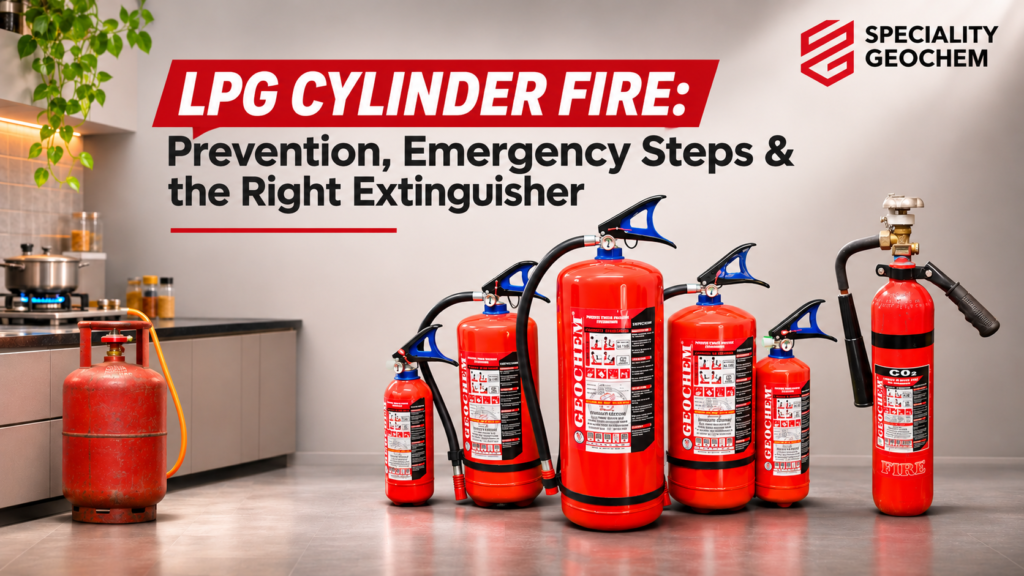
An ABC unit is the standard LPG cylinder fire extinguisher for homes, and one should hang on the kitchen wall near the door. Our 2 kg model, made to IS 15683, discharges for 10 to 12 seconds with a throw of 3 to 4 metres, which suits most kitchens. See the full range of ABC powder fire extinguishers.
For flare-ups at the stove, our fibreglass fire blanket smothers the flame without powder or mess. Read more about our fire blanket range.
Even after the flame is out, an extinguisher does not stop leaking gas. If the regulator is still open, the gas keeps escaping and can ignite again, so always shut off the supply.
[IMAGE 3: which extinguisher for an LPG fire]
When to evacuate instead of fighting the fire
Leave immediately, and call 101 or 112 from outside, if:
- The flames are bigger than a small flame at the regulator or tube
- You cannot reach the regulator without passing through fire
- The cylinder itself is engulfed in flames or is getting hot
- Smoke is filling the kitchen
- Your exit could be cut off
Close the kitchen door behind you as you leave. Warn your neighbours if you live in a flat, and tell the fire brigade where the cylinder is.
After the incident: checks before reuse
LPG cylinder fire safety does not end when the flames are out. Do not use the cylinder, regulator or stove again until they have been checked:
- Keep the regulator off and leave the kitchen ventilated until the smell has gone.
- Call your gas distributor to inspect the cylinder, regulator, tube and stove.
- Replace any tube or regulator that was exposed to flame, even if it looks fine.
- Check the fire blanket, and replace it if it is damaged or was exposed to intense heat.
- Get any fire extinguisher refilled after use, even a short burst.
Our fire extinguisher refilling guide explains the process and when it is needed.
Protect your kitchen from LPG fires
Our fire safety combo 3-in-1 brings together a 2 kg ABC extinguisher, a fire extinguisher ball and a 1 x 1 metre fibreglass fire blanket for kitchen gas fire safety in one kit, covering every step of LPG cylinder fire safety in this guide. For bulk orders for housing societies, hotels or canteens, call +91-9680211841 or email sales@new.specialitygeochem.com.
Frequently asked questions
How do I stop an LPG cylinder fire? The first rule of how to extinguish LPG fire is to stop the gas. Turn off the regulator if you can reach it safely, because cutting the gas is what stops the fire. Smother a small flame at the regulator or tube with a fire blanket, and use an ABC extinguisher on anything else burning. If the fire is large, leave and call 101.
Which fire extinguisher is used for LPG gas fire? An ABC dry powder extinguisher, which is rated for Class C fires involving gases such as LPG. A 2 kg unit suits most homes. Keep a fire blanket in the kitchen as well for small flames and pan flare-ups.
Can I use water on an LPG fire? No. Water cannot stop burning gas, and in a kitchen it can spread burning cooking oil. Shut off the gas supply and use a fire blanket or ABC extinguisher.
What should I do if I smell gas? Do not touch any switch or light a flame. Turn off the burners and the regulator, open doors and windows, and leave the kitchen. If the smell continues, call your gas distributor’s emergency service from outside.
How often should the LPG tube be replaced? Check it regularly and replace it at once if it cracks or hardens. A Suraksha LPG hose has a life of five years, so replace it before the expiry date printed on it, and get your whole LPG installation checked every two years.